
With the ever-growing challenges being faced by Eskom and the government initiatives being put in place to incentivise homeowners/complexes/businesses to make use of a more self-reliant, off grid/on grid hybrid electrical supply its inevitable the sectional title space is going to seek a solution to suit.
This presents a few challenges given the common property and the way a complex’s electrical reticulation is done. Geysers, stoves and air conditioners should never be connected to a solar photovoltaic solution in a domestic environment. It would mean the solution would be so oversized it would be financially unviable and would not likely realise a return on investment unless homeowners sacrificed their rights to buying electricity from a municipality and
placed it in the hands of a third party (business.) This would allow the business to amortize the cost by selling electricity to the complex, entirely contradictory to the concept of savings and security of supply.
Trustees in the sectional title environment, generally look at two aspects
- Electrical Savings
- Security of supply – less reliance on Eskom
Electrical Savings
When one is looking at household electrical savings, one first needs to understand the average usage per item in that household:
In an average South African Household, Consumption is more or less as follows:
| Cold Storage/Refrigeration | 5% |
| Space Heating | 16% |
| Laundry | 3% |
| Cooking | 8% |
| Lights | 6% |
| Geyser / Hot Water | 39% |
| Pool pump | 11% |
| Other | 12% |
| Total Usage | 100% |
Geyser / water heating is the single highest cost factor. It thus makes sense to tackle this area as a priority.
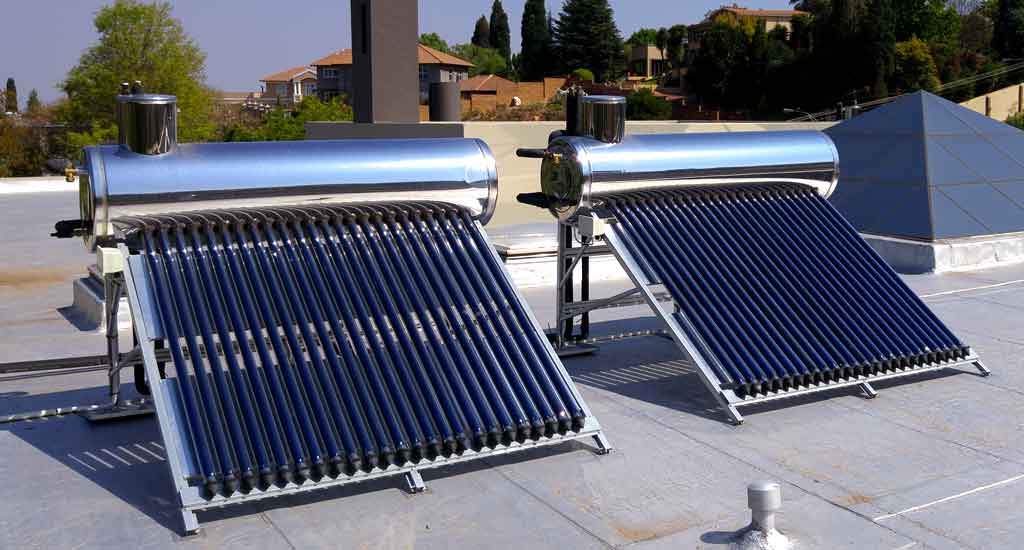
By eliminating the primary electrical heating source of a geyser and ideally installing a solar geyser, this includes a conventional electric geyser driven by a dedicated Photovoltaic solution, Sun = free hot water. Sized correctly this has the capability of saving 40 – 50% of the dwellings electrical bill. This has the lowest capital outlay with the highest, fastest return on investment.
Depending on the solution this has a secondary savings component in that if one replaces the geysers with new geysers and geysers with a 10 year warranty this changes the insurances risk exposure and savings can be derived as it will alter the claims ratio for the next 10 years and beyond. The electricity savings will more than likely payback over 5 years. In other words, even financing the system, the electrical savings alone probably pays for the system over some five years, thereafter, hot water heating and the system is almost cost free.
The WaterLite system is stainless steel, no anode and comes with a 10-year warranty. Thus, the added benefit is that such systems can be removed from “insurance maintenance cover” and immediately improve the insurance claims ratio, thus reducing premium. The higher the insurance savings, the faster the payback is accelerated.
In a nutshell, where schemes are experiencing a high loss ratio on their policies due to frequent mild steel geyser claims, and/or owners are simply keen to reduce costs, the WaterLite Stainless Steel Hot Water system is the ideal solution for both issues.
Security of Supply – less reliance on Eskom
Security of supply is the ability to secure the supply of electricity to keep a critical load of power on even during load shedding or rolling blackouts. We define this as lights, entertainment (TV, DSTV), Communications (WIFI), and a fridge it could also be linked to security. Cooking should be done on Gas as a backup as this is most cost effective. This solution comprises of solar panels, inverters and batteries and an adjustment to the DB board of the house to separate critical loads from non-critical loads.
It is also important to note that this also offers savings as the solution will work every day, however when referring to the above chart the possible savings on the table are somewhat limited, however ensures a security of supply. One also needs to consider service fees from the municipality and/or Eskom will remain in place even if we use absolutely no grid power, the charge is for the existing infrastructure.
One needs to view Electrical Savings and Security of supply as two separate issues. Both are independent of each other and do not need to be installed one after the other. One could start with one and revisit the other later depending on priorities.
After some media hype, many trustees and homeowners are asking whether the government are subsiding this by way of feed in tariffs. This may be so, but MaxLite / WaterLite are recommending a cautious approach to this as trends will change as government and Eskom’s needs change.
In other words, rather do not base or model the solution purely on the feed in tariff. Rather look at the scheme’s actual needs and treat ay feed in tariff as a bonus.
Regarding installing one system to supply power for the entire complex, the idea of supplying power to the complex needs to consider the infrastructure on the complex.
Security of supply then also needs to be considered in two parts.
- Common areas
Security of supply for the common areas such as security fence, gate/boom operations, lighting, security system and so on. Depending on needs and size, will determine the best and most cost-effective system. This is usually a priority area so that the scheme as a whole remains safe and secure at all times.
2. Individual Sections
One system to feed all sections already poses problems. As trustees, one can never effectively manage and limit people’s individual usage or start dictating how a person uses their energy. Thus it is sensible to provide each owner with dedicated solar power so that one person’s use does not affect the next person’s power. Practically, one cannot separate an electrical board to remove geysers and stoves and the like if you just supply power to the entire complex. This means there will be reliance on the grid as the neighbour may just use it as they want rather than following guidelines as to when to use power and when not to.
Benefits of a system per individual section:
- Independence of each section
- Reliability of system
- Simplicity of maintenance
- Technical issues are isolated to that unit only
- Solar geysers offer great electrical savings and long-term warranty with secondary insurance savings.
- Independence from the grid at a reasonable size and cost
- Retention of the control over electricity purchase from municipality and or Eskom
What steps should the trustees follow:
Step One
Have MaxLite consult with the trustees to ascertain needs. Initial consult will involve a site visit and gathering of information so that the MaxLite Team can collate information and thereafter provide trustees with various options.
Step Two
Maxlite tables options and costs and implementation timelines. Financing options included.
Step Three
Trustees engage with a specialist sectional title attorney for an initial brief on any rule changes required in terms of the proposal put forward by Maxlite.
Step Four
Call a Meeting of Owners to consider and decide on the best solution for the scheme as a whole.
Ensure that the correct resolutions are adopted for the improvements, dealing with responsibilities and financing.
Step Five
Consult with specialist sectional title attorney to finalise rules and proceed with the project.